Which of the Following Statements About Eye Movements During Reading Are False?

A sample hypnogram (electroencephalogram of sleep) showing slumber cycles characterized by increasing paradoxical (REM) sleep.

EEG of a mouse that shows REM sleep being characterized past prominent theta-rhythm
Rapid middle movement slumber (REM sleep or REMS) is a unique phase of slumber in mammals and birds, characterized past random rapid movement of the eyes, accompanied by low muscle tone throughout the torso, and the propensity of the sleeper to dream vividly.
The REM phase is also known as paradoxical sleep (PS) and sometimes desynchronized sleep, because of physiological similarities to waking states including rapid, depression-voltage desynchronized brain waves. Electrical and chemical action regulating this phase seems to originate in the brain stem, and is characterized most notably by an affluence of the neurotransmitter acetylcholine, combined with a nearly complete absenteeism of monoamine neurotransmitters histamine, serotonin and norepinephrine.[1]
REM sleep is physiologically unlike from the other phases of sleep, which are collectively referred to as non-REM sleep (NREM slumber, NREMS, synchronized sleep). REM and non-REM sleep alternate inside 1 sleep cycle, which lasts about 90 minutes in adult humans. As sleep cycles go along, they shift towards a higher proportion of REM sleep. The transition to REM sleep brings marked physical changes, start with electric bursts called "ponto-geniculo-occipital waves" (PGO waves) originating in the encephalon stem. Organisms in REM sleep suspend central homeostasis, assuasive large fluctuations in respiration, thermoregulation and apportionment which do not occur in whatsoever other modes of sleeping or waking. The body abruptly loses muscle tone, a land known as REM atonia.[1] [2]
In 1953, Professor Nathaniel Kleitman and his student Eugene Aserinsky defined rapid center movement and linked it to dreams. REM sleep was farther described by researchers, including William Dement and Michel Jouvet. Many experiments have involved awakening examination subjects whenever they brainstorm to enter the REM phase, thereby producing a state known as REM deprivation. Subjects allowed to sleep commonly again usually experience a minor REM rebound. Techniques of neurosurgery, chemical injection, electroencephalography, positron emission tomography, and reports of dreamers upon waking, have all been used to report this stage of slumber.[three]
Physiology [edit]
Electric activeness in the brain [edit]
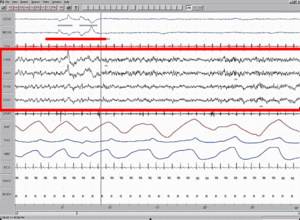
Polysomnographic record of REM Sleep. EEG highlighted by red box. Eye movement highlighted by red line.
REM sleep is coined "paradoxical" considering of its similarities to wakefulness. Although the body is paralyzed, the brain acts as if information technology is somewhat awake, with cerebral neurons firing with the same overall intensity as in wakefulness.[4] [5] Electroencephalography during REM deep sleep reveals fast, depression amplitude, desynchronized neural oscillation (brainwaves) that resemble the pattern seen during wakefulness, which differ from the deadening δ (delta) waves pattern of NREM deep slumber.[one] [six] An important element of this contrast is the three–10 Hz theta rhythm in the hippocampus[7] and 40–lx Hz gamma waves in the cortex; patterns of EEG activeness similar to these rhythms are besides observed during wakefulness.[viii] The cortical and thalamic neurons in the waking and REM sleeping brain are more depolarized (burn more readily) than in the NREM deep sleeping brain.[9] Human theta moving ridge activity predominates during REM slumber in both the hippocampus and the cortex.[10] [11]
During REM sleep, electrical connectivity amidst dissimilar parts of the brain manifests differently than during wakefulness. Frontal and posterior areas are less coherent in well-nigh frequencies, a fact which has been cited in relation to the chaotic experience of dreaming. Yet, the posterior areas are more than coherent with each other; as are the correct and left hemispheres of the brain, peculiarly during lucid dreams.[12] [thirteen]
Brain free energy use in REM sleep, as measured past oxygen and glucose metabolism, equals or exceeds energy utilisation in waking. The rate in non-REM sleep is 11–40% lower.[fourteen]
Brain stem [edit]
Neural activity during REM sleep seems to originate in the brain stem, especially the pontine tegmentum and locus coeruleus. REM sleep is punctuated and immediately preceded past PGO (ponto-geniculo-occipital) waves, bursts of electric action originating in the brain stem.[fifteen] (PGO waves have long been measured directly in cats but not in humans because of constraints on experimentation; however, comparable effects accept been observed in humans during "phasic" events which occur during REM sleep, and the existence of like PGO waves is thus inferred.)[13] These waves occur in clusters nearly every 6 seconds for 1–ii minutes during the transition from deep to paradoxical sleep.[6] They showroom their highest amplitude upon moving into the visual cortex and are a cause of the "rapid center movements" in paradoxical sleep.[16] [17] [fourteen] Other muscles may besides contract under the influence of these waves.[eighteen]
Forebrain [edit]
Research in the 1990s using positron emission tomography (PET) confirmed the role of the brain stem and suggested that, inside the forebrain, the limbic and paralimbic systems showed more activation than other areas.[4] The areas activated during REM sleep are approximately changed to those activated during non-REM sleep[xiv] and display greater activity than in quiet waking. The "anterior paralimbic REM activation area" (APRA) includes areas linked with emotion, memory, fear and sex activity, and may thus relate to the experience of dreaming during REMS.[13] [19] More contempo PET research has indicated that the distribution of brain activity during REM sleep varies in correspondence with the type of activity seen in the prior period of wakefulness.[iv]
The superior frontal gyrus, medial frontal areas, intraparietal sulcus, and superior parietal cortex, areas involved in sophisticated mental activity, show equal activity in REM sleep as in wakefulness. The amygdala is also active during REM sleep and may participate in generating the PGO waves, and experimental suppression of the amygdala results in less REM sleep.[20] The amygdala may also regulate cardiac office in lieu of the less active insular cortex.[4]
Chemicals in the brain [edit]
Compared to slow-wave sleep, both waking and paradoxical slumber involve higher utilise of the neurotransmitter acetylcholine, which may cause the faster brainwaves. The monoamine neurotransmitters norepinephrine, serotonin and histamine are completely unavailable. Injections of acetylcholinesterase inhibitor, which finer increases bachelor acetylcholine, have been plant to induce paradoxical sleep in humans and other animals already in slow-moving ridge sleep. Carbachol, which mimics the effect of acetylcholine on neurons, has a similar influence. In waking humans, the same injections produce paradoxical sleep only if the monoamine neurotransmitters have already been depleted.[one] [21] [22] [23] [24]
Two other neurotransmitters, orexin and gamma-Aminobutyric acid (GABA), seem to promote wakefulness, diminish during deep slumber, and inhibit paradoxical sleep.[i] [25]
Unlike the abrupt transitions in electric patterns, the chemical changes in the brain testify continuous periodic oscillation.[26]
Models of REM regulation [edit]
Co-ordinate to the activation-synthesis hypothesis proposed past Robert McCarley and Allan Hobson in 1975–1977, control over REM slumber involves pathways of "REM-on" and "REM-off" neurons in the brain stalk. REM-on neurons are primarily cholinergic (i.e., involve acetylcholine); REM-off neurons actuate serotonin and noradrenaline, which among other functions suppress the REM-on neurons. McCarley and Hobson suggested that the REM-on neurons actually stimulate REM-off neurons, thereby serving as the machinery for the cycling betwixt REM and non-REM sleep.[1] [21] [23] [27] They used Lotka–Volterra equations to describe this cyclical changed relationship.[28] Kayuza Sakai and Michel Jouvet advanced a similar model in 1981.[25] Whereas acetylcholine manifests in the cortex equally during wakefulness and REM, it appears in higher concentrations in the brain stalk during REM.[29] The withdrawal of orexin and GABA may cause the absence of the other excitatory neurotransmitters;[30] researchers in recent years increasingly include GABA regulation in their models.[31]
Eye movements [edit]
Most of the eye movements in "rapid eye movement" sleep are in fact less rapid than those ordinarily exhibited by waking humans. They are also shorter in duration and more likely to loop back to their starting betoken. Virtually seven such loops take place over one minute of REM sleep. In tiresome-wave sleep, the optics can migrate apart; all the same, the eyes of the paradoxical sleeper movement in tandem.[32] These eye movements follow the ponto-geniculo-occipital waves originating in the brain stalk.[16] [17] The center movements themselves may relate to the sense of vision experienced in the dream,[33] but a direct relationship remains to be clearly established. Congenitally blind people, who practice not typically have visual imagery in their dreams, still move their eyes in REM sleep.[14] An alternative explanation suggests that the functional purpose of REM sleep is for procedural memory processing, and the rapid eye motion is only a side outcome of the brain processing the eye-related procedural retention.[34] [35]
Apportionment, respiration, and thermoregulation [edit]
Generally speaking, the trunk suspends homeostasis during paradoxical sleep. Heart rate, cardiac pressure, cardiac output, arterial pressure level, and breathing rate quickly become irregular when the body moves into REM sleep.[36] In general, respiratory reflexes such as response to hypoxia diminish. Overall, the brain exerts less control over animate; electrical stimulation of respiration-linked brain areas does non influence the lungs, equally it does during non-REM slumber and in waking.[37] The fluctuations of middle rate and arterial pressure tend to coincide with PGO waves and rapid eye movements, twitches, or sudden changes in breathing.[38]
Erections of the penis (nocturnal penile tumescence or NPT) normally accompany REM sleep in rats and humans.[39] If a male has erectile dysfunction (ED) while awake, simply has NPT episodes during REM, it would suggest that the ED is from a psychological rather than a physiological crusade. In females, erection of the clitoris (nocturnal clitoral tumescence or NCT) causes enlargement, with accompanying vaginal blood flow and transudation (i.e. lubrication). During a normal night of slumber, the penis and clitoris may exist erect for a full fourth dimension of from one hr to as long as iii and a one-half hours during REM.[40]
Trunk temperature is not well regulated during REM slumber, and thus organisms become more sensitive to temperatures outside their thermoneutral zone. Cats and other minor furry mammals volition shiver and breathe faster to regulate temperature during NREMS—simply not during REMS.[41] With the loss of muscle tone, animals lose the power to regulate temperature through body movement. (However, even cats with pontine lesions preventing muscle atonia during REM did not regulate their temperature past shivering.)[42] Neurons which typically activate in response to cold temperatures—triggers for neural thermoregulation—simply exercise not fire during REM slumber, as they do in NREM sleep and waking.[43]
Consequently, hot or common cold environmental temperatures can reduce the proportion of REM slumber, equally well as amount of total slumber.[44] [45] In other words, if at the stop of a phase of deep sleep, the organism'southward thermal indicators autumn outside of a sure range, it will not enter paradoxical sleep lest deregulation allow temperature to drift farther from the desirable value.[46] This machinery can exist 'fooled' by artificially warming the brain.[47]
Muscle [edit]
REM atonia, an virtually consummate paralysis of the body, is achieved through the inhibition of motor neurons. When the torso shifts into REM slumber, motor neurons throughout the body undergo a procedure chosen hyperpolarization:[48] their already-negative membrane potential decreases past another 2–10 millivolts, thereby raising the threshold which a stimulus must overcome to excite them. Muscle inhibition may issue from unavailability of monoamine neurotransmitters (restraining the abundance of acetylcholine in the brainstem) and possibly from mechanisms used in waking muscle inhibition.[49] The medulla oblongata, located between pons and spine, seems to accept the chapters for organism-wide muscle inhibition.[2] Some localized twitching and reflexes tin can still occur.[50] Pupils contract.[18]
Lack of REM atonia causes REM behavior disorder, sufferers of which physically human activity out their dreams,[51] or conversely "dream out their acts", under an alternative theory on the relationship between muscle impulses during REM and associated mental imagery (which would besides employ to people without the condition, except that commands to their muscles are suppressed).[52] This is unlike from conventional sleepwalking, which takes identify during irksome-wave sleep, not REM.[53] Narcolepsy, by contrast, seems to involve excessive and unwanted REM atonia: cataplexy and excessive daytime sleepiness while awake, hypnagogic hallucinations before inbound slow-wave sleep, or slumber paralysis while waking.[54] Other psychiatric disorders including depression have been linked to disproportionate REM slumber.[55] Patients with suspected sleep disorders are typically evaluated by polysomnogram.[56] [57]
Lesions of the pons to prevent atonia accept induced functional "REM behavior disorder" in animals.[58]
Psychology [edit]
Dreaming [edit]
Rapid center movement sleep (REM) has since its discovery been closely associated with dreaming. Waking up sleepers during a REM phase is a mutual experimental method for obtaining dream reports; 80% of neurotypical people can give some kind of dream report under these circumstances.[59] [60] Sleepers awakened from REM tend to give longer, more narrative descriptions of the dreams they were experiencing, and to gauge the duration of their dreams as longer.[xiv] [61] Lucid dreams are reported far more oftentimes in REM sleep.[62] (In fact these could be considered a hybrid state combining essential elements of REM sleep and waking consciousness.)[fourteen] The mental events which occur during REM most commonly have dream hallmarks including narrative structure, convincingness (east.one thousand., experiential resemblance to waking life), and incorporation of instinctual themes.[14] Sometimes, they include elements of the dreamer's recent feel taken directly from episodic retentiveness.[4] By ane estimate, lxxx% of dreams occur during REM.[63]
Hobson and McCarley proposed that the PGO waves feature of "phasic" REM might supply the visual cortex and forebrain with electrical excitement which amplifies the hallucinatory aspects of dreaming.[22] [27] Nevertheless, people woken up during sleep do not report significantly more bizarre dreams during phasic REMS, compared to tonic REMS.[61] Another possible relationship betwixt the ii phenomena could exist that the college threshold for sensory interruption during REM sleep allows the encephalon to travel further along unrealistic and peculiar trains of thought.[61]
Some dreaming tin have place during non-REM sleep. "Light sleepers" can experience dreaming during stage two non-REM sleep, whereas "deep sleepers", upon awakening in the same stage, are more likely to study "thinking" but not "dreaming". Certain scientific efforts to assess the uniquely baroque nature of dreams experienced while asleep were forced to conclude that waking idea could be just equally bizarre, particularly in weather of sensory deprivation.[61] [64] Considering of not-REM dreaming, some sleep researchers have strenuously contested the importance of connecting dreaming to the REM sleep phase. The prospect that well-known neurological aspects of REM do non themselves cause dreaming suggests the need to re-examine the neurobiology of dreaming per se.[65] Some researchers (Dement, Hobson, Jouvet, for instance) tend to resist the thought of disconnecting dreaming from REM sleep.[14] [66]
Effects of SSRIs [edit]
Previous research has shown that Selective Serotonin Reuptake Inhibitors (SSRIs) have an of import outcome on REM slumber neurobiology and dreaming.[67] A report at Harvard Medical School in 2000 tested the effects of paroxetine and fluvoxamine on healthy young adult male and females for 31 days: a drug-gratis baseline week, 19 days on either paroxetine or fluvoxamine with morning time and evening doses, and 5 days of accented discontinuation.[68] Results showed that SSRI handling decreased the average corporeality of dream recall frequency in comparison to baseline measurements every bit a outcome of serotonergic REM suppression.[68] Fluvoxamine increased the length of dream reporting, bizarreness of dreams equally well as the intensity of REM sleep. These effects were the greatest during astute discontinuation compared to treatment and baseline days.[68] However, the subjective intensity of dreaming increased[68] and the proclivity to enter REM sleep was decreased during SSRI handling compared to baseline and discontinuation days.[68]
Creativity [edit]
Later waking from REM slumber, the heed seems "hyperassociative"—more receptive to semantic priming furnishings. People awakened from REM have performed better on tasks like anagrams and creative trouble solving.[69]
Sleep aids the procedure by which creativity forms associative elements into new combinations that are useful or meet some requirement.[70] This occurs in REM sleep rather than in NREM sleep.[71] [72] Rather than existence due to memory processes, this has been attributed to changes during REM sleep in cholinergic and noradrenergic neuromodulation.[71] High levels of acetylcholine in the hippocampus suppress feedback from hippocampus to the neocortex, while lower levels of acetylcholine and norepinephrine in the neocortex encourage the uncontrolled spread of associational activity within neocortical areas.[73] This is in dissimilarity to waking consciousness, where higher levels of norepinephrine and acetylcholine inhibit recurrent connections in the neocortex. REM slumber through this process adds creativity past assuasive "neocortical structures to reorganise associative hierarchies, in which data from the hippocampus would be reinterpreted in relation to previous semantic representations or nodes."[71]
Timing [edit]
Sample hypnogram (electroencephalogram of sleep) showing sleep cycles characterized past increasing paradoxical (REM) sleep.
In the ultradian sleep cycle, an organism alternates betwixt deep sleep (boring, large, synchronized encephalon waves) and paradoxical sleep (faster, desynchronized waves). Sleep happens in the context of the larger circadian rhythm, which influences sleepiness and physiological factors based on timekeepers within the trunk. Sleep tin can be distributed throughout the day or clustered during one role of the rhythm: in nocturnal animals, during the twenty-four hours, and in diurnal animals, at night.[74] The organism returns to homeostatic regulation nigh immediately after REM sleep ends.[75]
During a night of sleep, humans usually experience about 4 or five periods of REM slumber; they are shorter (~15 min) at the showtime of the night and longer (~25 min) toward the stop. Many animals and some people tend to wake, or experience a period of very light sleep, for a short time immediately after about of REM. The relative amount of REM sleep varies considerably with historic period. A newborn baby spends more than 80% of full slumber time in REM.[76]
REM sleep typically occupies 20–25% of total slumber in adult humans: nigh 90–120 minutes of a nighttime's slumber. The first REM episode occurs nigh 70 minutes after falling comatose. Cycles of about 90 minutes each follow, with each cycle including a larger proportion of REM sleep.[26] (The increased REM sleep later in the night is continued with the circadian rhythm and occurs even in people who did not sleep in the beginning part of the night.)[77] [78]
In the weeks after a human infant is born, as its nervous arrangement matures, neural patterns in slumber begin to show a rhythm of REM and non-REM sleep. (In faster-developing mammals, this process occurs in utero.)[79] Infants spend more than time in REM sleep than adults. The proportion of REM slumber and so decreases significantly in childhood. Older people tend to sleep less overall, just sleep in REM for well-nigh the same absolute time (and therefore spend a greater proportion of sleep in REM).[80] [63]
Rapid eye movement sleep can be subclassified into tonic and phasic modes.[81] Tonic REM is characterized by theta rhythms in the brain; phasic REM is characterized by PGO waves and actual "rapid" center movements. Processing of external stimuli is heavily inhibited during phasic REM, and recent evidence suggests that sleepers are more difficult to agitate from phasic REM than in ho-hum-wave sleep.[17]
Deprivation furnishings [edit]
Selective REMS deprivation causes a meaning increment in the number of attempts to go into REM stage while asleep. On recovery nights, an private volition commonly move to stage 3 and REM slumber more quickly and experience a REM rebound, which refers to an increase in the time spent in REM stage over normal levels. These findings are consistent with the idea that REM sleep is biologically necessary.[82] [83] However, the "rebound" REM sleep ordinarily does not last fully equally long as the estimated length of the missed REM periods.[77]
After the deprivation is consummate, mild psychological disturbances, such as anxiety, irritability, hallucinations, and difficulty concentrating may develop and appetite may increase. There are also positive consequences of REM deprivation. Some symptoms of low are constitute to be suppressed past REM deprivation; assailment may increment, and eating behavior may get disrupted.[83] [84] Higher norepinepherine is a possible cause of these results.[21] Whether and how long-term REM deprivation has psychological effects remains a thing of controversy. Several reports have indicated that REM deprivation increases aggression and sexual beliefs in laboratory test animals.[83] Rats deprived of paradoxical slumber die in iv–6 weeks (twice the time earlier death in case of total sleep deprivation). Hateful body temperature falls continually during this period.[78]
It has been suggested that acute REM sleep deprivation tin can ameliorate certain types of depression—when depression appears to be related to an imbalance of sure neurotransmitters. Although sleep impecuniousness in general annoys most of the population, it has repeatedly been shown to convalesce depression, admitting temporarily.[85] More than than half the individuals who experience this relief study it to be rendered ineffective afterwards sleeping the following night. Thus, researchers have devised methods such as altering the slumber schedule for a span of days post-obit a REM impecuniousness period[86] and combining sleep-schedule alterations with pharmacotherapy[87] to prolong this outcome. Antidepressants (including selective serotonin reuptake inhibitors, tricyclics, and monoamine oxidase inhibitors) and stimulants (such as amphetamine, methylphenidate and cocaine) interfere with REM sleep by stimulating the monoamine neurotransmitters which must be suppressed for REM sleep to occur. Administered at therapeutic doses, these drugs may end REM sleep entirely for weeks or months. Withdrawal causes a REM rebound.[63] [88] Sleep deprivation stimulates hippocampal neurogenesis much as antidepressants practise, just whether this effect is driven by REM sleep in particular is unknown.[89]
In other animals [edit]
Rapid middle movement of a canis familiaris
Although information technology manifests differently in unlike animals, REM sleep or something like it occurs in all country mammals—as well as in birds. The primary criteria used to place REM are the change in electrical action, measured by EEG, and loss of muscle tone, interspersed with bouts of twitching in phasic REM.[91] The amount of REM sleep and cycling varies among animals; predators experience more than REM sleep than prey.[21] Larger animals likewise tend to stay in REM for longer, possibly because higher thermal inertia of their brains and bodies allows them to tolerate longer suspension of thermoregulation.[92] The period (full wheel of REM and not-REM) lasts for well-nigh 90 minutes in humans, 22 minutes in cats, and 12 minutes in rats.[93] In utero, mammals spend more than one-half (50–eighty%) of a 24-hour day in REM sleep.[26]
Sleeping reptiles do not seem to have PGO waves or the localized brain activation seen in mammalian REM. All the same, they exercise exhibit sleep cycles with phases of REM-like electric action measurable by EEG.[91] A recent study constitute periodic centre movements in the central bearded dragon of Australia, leading its authors to speculate that the common ancestor of amniotes may therefore have manifested some precursor to REMS.[94]
Sleep deprivation experiments on not-human animals can exist set upwardly differently than those on humans. The "blossom pot" method involves placing a laboratory beast above water on a platform then modest that it falls off upon losing muscle tone. The naturally rude awakening which results may arm-twist changes in the organism which necessarily exceed the simple absence of a sleep phase.[95] This method also stops working after most 3 days equally the subjects (typically rats) lose their volition to avoid the water.[78] Another method involves computer monitoring of encephalon waves, consummate with automatic mechanized shaking of the cage when the test animal drifts into REM sleep.[96]
Possible functions [edit]
Some researchers debate that the perpetuation of a complex brain procedure such every bit REM sleep indicates that it serves an important part for the survival of mammalian and avian species. It fulfills important physiological needs vital for survival to the extent that prolonged REM slumber impecuniousness leads to death in experimental animals. In both humans and experimental animals, REM sleep loss leads to several behavioral and physiological abnormalities. Loss of REM sleep has been noticed during diverse natural and experimental infections. Survivability of the experimental animals decreases when REM sleep is totally attenuated during infection; this leads to the possibility that the quality and quantity of REM sleep is by and large essential for normal body physiology.[97] Further, the existence of a "REM rebound" effect suggests the possibility of a biological need for REM sleep.
While the precise function of REM slumber is not well understood, several theories have been proposed.
Memory [edit]
Sleep in general aids memory. REM sleep may favor the preservation of certain types of memories: specifically, procedural memory, spatial memory, and emotional retentivity. In rats, REM sleep increases following intensive learning, particularly several hours later, and sometimes for multiple nights. Experimental REM sleep deprivation has sometimes inhibited retentiveness consolidation, especially regarding circuitous processes (e.yard., how to escape from an elaborate maze).[98] In humans, the best show for REM's improvement of retentiveness pertains to learning of procedures—new means of moving the body (such as trampoline jumping), and new techniques of problem solving. REM impecuniousness seemed to impair declarative (i.eastward., factual) retentiveness just in more complex cases, such as memories of longer stories.[99] REM sleep apparently counteracts attempts to suppress certain thoughts.[69]
According to the dual-process hypothesis of sleep and retentivity, the 2 major phases of sleep represent to different types of memory. "Night half" studies accept tested this hypothesis with memory tasks either begun earlier sleep and assessed in the middle of the night, or begun in the center of the night and assessed in the morning.[100] Tiresome-wave slumber, office of non-REM sleep, appears to exist of import for declarative retentiveness. Artificial enhancement of the not-REM slumber improves the next-day think of memorized pairs of words.[101] Tucker et al. demonstrated that a daytime nap containing solely not-REM slumber enhances declarative retentivity—but not procedural memory.[102] According to the sequential hypothesis, the two types of sleep work together to consolidate retention.[103]
Sleep researcher Jerome Siegel has observed that extreme REM deprivation does not significantly interfere with retentiveness. I case study of an private who had little or no REM slumber due to a shrapnel injury to the brainstem did not find the individual's retention to be impaired. Antidepressants, which suppress REM sleep, show no prove of impairing memory and may better it.[88]
Graeme Mitchison and Francis Crick proposed in 1983 that by virtue of its inherent spontaneous action, the function of REM sleep "is to remove certain undesirable modes of interaction in networks of cells in the cerebral cortex"—a process they characterize as "unlearning". As a result, those memories which are relevant (whose underlying neuronal substrate is potent enough to withstand such spontaneous, chaotic activation) are further strengthened, whilst weaker, transient, "noise" memory traces disintegrate.[104] Memory consolidation during paradoxical sleep is specifically correlated with the periods of rapid eye movement, which exercise not occur continuously. One caption for this correlation is that the PGO electrical waves, which precede the eye movements, also influence memory.[16] REM sleep could provide a unique opportunity for "unlearning" to occur in the basic neural networks involved in homeostasis, which are protected from this "synaptic downscaling" effect during deep sleep.[105]
Neural ontogeny [edit]
REM sleep prevails most after birth, and diminishes with age. According to the "ontogenetic hypothesis", REM (also known in neonates equally agile sleep) aids the developing brain past providing the neural stimulation that newborns need to class mature neural connections.[106] Sleep deprivation studies have shown that deprivation early in life tin can result in behavioral problems, permanent sleep disruption, and decreased brain mass.[107] [79] The strongest evidence for the ontogenetic hypothesis comes from experiments on REM deprivation, and from the evolution of the visual organisation in the lateral geniculate nucleus and master visual cortex.[79]
Defensive immobilization [edit]
Ioannis Tsoukalas of Stockholm Academy has hypothesized that REM slumber is an evolutionary transformation of a well-known defensive mechanism, the tonic immobility reflex. This reflex, also known as animal hypnosis or death feigning, functions as the last line of defense against an attacking predator and consists of the total immobilization of the brute so that it appears dead. Tsoukalas argues that the neurophysiology and phenomenology of this reaction shows hit similarities to REM slumber; for example, both reactions exhibit brainstem command, cholinergic neurotransmission, paralysis, hippocampal theta rhythm, and thermoregulatory changes.[108] [109]
Shift of gaze [edit]
According to "scanning hypothesis", the directional properties of REM sleep are related to a shift of gaze in dream imagery. Confronting this hypothesis is that such eye movements occur in those born blind and in fetuses in spite of lack of vision. Also, binocular REMs are non-conjugated (i.east., the ii eyes do non indicate in the aforementioned direction at a time) and then lack a fixation indicate. In back up of this theory, research finds that in goal-oriented dreams, middle gaze is directed towards the dream action, adamant from correlations in the eye and trunk movements of REM sleep beliefs disorder patients who enact their dreams.[110]
Oxygen supply to cornea [edit]
Dr. David Chiliad. Maurice, an eye specialist and erstwhile offshoot professor at Columbia University, proposed that REM sleep was associated with oxygen supply to the cornea, and that aqueous humor, the liquid between cornea and iris, was stagnant if not stirred.[111] Among the supportive evidence, he calculated that if aqueous sense of humour was stagnant, oxygen from the iris had to achieve the cornea past diffusion through aqueous humor, which was not sufficient. According to the theory, when the organism is awake, centre motility (or cool environmental temperature) enables the aqueous sense of humor to circulate. When the organism is sleeping, REM provides the much needed stir to aqueous humor. This theory is consistent with the observation that fetuses, as well as centre-sealed newborn animals, spend much fourth dimension in REM sleep, and that during a normal sleep, a person's REM slumber episodes become progressively longer deeper into the night. However, owls experience REM sleep, but do non motility their caput more than in non-REM sleep[112] and is well known that owls' eyes are about immobile.[113]
Other theories [edit]
Another theory suggests that monoamine shutdown is required so that the monoamine receptors in the brain can recover to regain total sensitivity.
The sentinel hypothesis of REM sleep was put frontward by Frederick Snyder in 1966. It is based upon the ascertainment that REM slumber in several mammals (the rat, the hedgehog, the rabbit, and the rhesus monkey) is followed by a brief enkindling. This does not occur for either cats or humans, although humans are more likely to wake from REM sleep than from NREM slumber. Snyder hypothesized that REM sleep activates an animal periodically, to scan the environs for possible predators. This hypothesis does not explicate the muscle paralysis of REM sleep; however, a logical analysis might suggest that the muscle paralysis exists to foreclose the animal from fully waking upwardly unnecessarily, and allowing it to return easily to deeper sleep.[114] [115] [116]
Jim Horne, a sleep researcher at Loughborough University, has suggested that REM in modern humans compensates for the reduced need for wakeful food foraging.[viii]
Other theories are that REM sleep warms the encephalon, stimulates and stabilizes the neural circuits that accept not been activated during waking, or creates internal stimulation to aid development of the CNS; while some fence that REM lacks any purpose, and simply results from random brain activation.[110] [117]
Furthermore, eye movements play a role in certain psychotherapies such as Eye Movement Desensitization and Reprocessing (EMDR).
Discovery and further research [edit]
Recognition of different types of sleep can be seen in the literature of ancient India and Rome. Observers have long noticed that sleeping dogs twitch and move only only at certain times.[118]
In 1937, the High german scientist Richard Klaue first discovered a period of fast electrical activity in the brains of sleeping cats. In 1944, Ohlmeyer reported ninety-minute ultradian slumber cycles involving male person erections lasting for 25 minutes.[119] At University of Chicago in 1952, Eugene Aserinsky, Nathaniel Kleitman, and William C. Bewilder, discovered phases of rapid eye movement during sleep, and connected these to dreaming. Their article was published September 10, 1953.[120] Aserinsky, then Kleitman, start observed the centre movements and accompanying neuroelectrical activity in their ain children.[118] [121]
William Dement advanced the study of REM deprivation, with experiments in which subjects were awoken every fourth dimension their EEG indicated the commencement of REM slumber. He published "The Result of Dream Impecuniousness" in June 1960.[122] ("REM deprivation" has become the more common term post-obit subsequent enquiry indicating the possibility of non-REM dreaming.)
In the following two decades, neurosurgical experiments past Michel Jouvet and others added an understanding of atonia, and suggested the importance of the pontine tegmentum (dorsolateral pons) in enabling and regulating paradoxical slumber.[21] Jouvet and others found that damaging the reticular formation of the brainstem inhibited this blazon of sleep.[2] Jouvet coined the name "paradoxical sleep" in 1959 and in 1962 published results indicating that it could occur in a cat with its entire forebrain removed.[25] [117] [18] The mechanisms of muscle atonia was initially proposed by Horace Winchell Magoun in 1940s, and subsequently confirmed by Rodolfo Llinás in 1960s.[123]
Hiroki R. Ueda and his colleagues identified muscarinic receptor genes M1 (Chrm1) and M3 (Chrm3) as essential genes for REMS sleep.[124]
Encounter too [edit]
- Neuroscience of sleep
- Pedunculopontine nucleus (PPN)
- Slumber and learning
References [edit]
- ^ a b c d e f Ritchie Due east. Brown & Robert W. McCarley (2008), "Neuroanatomical and neurochemical basis of wakefulness and REM slumber systems", in Neurochemistry of Sleep and Wakefulness ed. Monti et al.
- ^ a b c Yuan-Yang Lai & Jerome M. Siegel (1999), "Muscle Atonia in REM Sleep", in Rapid Middle Movement Slumber ed. Mallick & Inoué.
- ^ Deboer, T (2007). "Technologies of sleep research". Cell Mol Life Sci. 64 (10): 1227–1235. doi:10.1007/s00018-007-6533-0. PMC2771137. PMID 17364139.
- ^ a b c d e Luca Matarazzo, Ariane Foret, Laura Mascetti, Vincenzo Muto, Anahita Shaffii, & Pierre Maquet, "A systems-level arroyo to human REM sleep"; in Mallick et al, eds. (2011).
- ^ Myers, David (2004). Psychology (7th ed.). New York: Worth Publishers. p. 268. ISBN978-0-7167-8595-viii . Retrieved 2010-01-09 .
0716785951.
- ^ a b Steriade & McCarley (1990), "Brainstem Control of Wakefulness and Slumber", §one.2 (pp. 7–23).
- ^ Steriade & McCarley (1990), "Brainstem Control of Wakefulness and Sleep", §7.ii–3 (pp. 206–208).
- ^ a b Jim Horne (2013), "Why REM sleep? Clues beyond the laboratory in a more than challenging world", Biological Psychology 92.
- ^ Steriade & McCarley (1990), "Brainstem Command of Wakefulness and Sleep", §8.1 (pp. 232–243).
- ^ Lomas T, Ivtzan I, Fu CH (2015). "A systematic review of the neurophysiology of mindfulness on EEG oscillations" (PDF). Neuroscience & Biobehavioral Reviews. 57: 401–410. doi:x.1016/j.neubiorev.2015.09.018. PMID 26441373. S2CID 7276590.
- ^ Hinterberger T, Schmidt S, Kamei T, Walach H (2014). "Decreased electrophysiological activity represents the conscious state of emptiness in meditation". Frontiers in Psychology. 5: 99. doi:10.3389/fpsyg.2014.00099. PMC3925830. PMID 24596562.
- ^ Jayne Gackenbach, "Interhemispheric EEG Coherence in REM Sleep and Meditation: The Lucid Dreaming Connection" in Antrobus & Bertini (eds.), The Neuropsychology of Sleep and Dreaming.
- ^ a b c Edward F. Footstep-Schott, "REM sleep and dreaming", in Mallick et al, eds. (2011).
- ^ a b c d e f m h J. Alan Hobson, Edward F. Footstep-Scott, & Robert Stickgold (2000), "Dreaming and the brain: Toward a cognitive neuroscience of conscious states", Behavioral and Encephalon Sciences 23.
- ^ Steriade & McCarley (1990), "Brainstem Command of Wakefulness and Sleep", §nine.1–2 (pp. 263–282).
- ^ a b c Subimal Datta (1999), "PGO Wave Generation: Mechanism and functional significance", in Rapid Middle Movement Sleep ed. Mallick & Inoué.
- ^ a b c Ummehan Ermis, Karsten Krakow, & Ursula Voss (2010), "Arousal thresholds during human being tonic and phasic REM slumber", Periodical of Sleep Research 19.
- ^ a b c Siegel JM (2009). "The Neurobiology of Slumber". Seminars in Neurology. 29 (4): 277–296. doi:10.1055/due south-0029-1237118. PMID 19742406.
- ^ Nofzinger EA; et al. (1997). "Forebrain activation in REM sleep: an FDG PET study". Encephalon Research. 770 (1–two): 192–201. doi:10.1016/s0006-8993(97)00807-x. PMID 9372219. S2CID 22764238.
- ^ Larry D. Sanford & Richard J. Ross, "Amygdalar regulation of REM sleep"; in Mallick et al. (2011).
- ^ a b c d eastward Birendra N. Mallick, Vibha Madan, & Sushil 1000. Jha (2008), "Rapid eye move slumber regulation by modulation of the noradrenergic arrangement", in Neurochemistry of Sleep and Wakefulness ed. Monti et al.
- ^ a b Hobson JA (2009). "REM slumber and dreaming: towards a theory of protoconsciousness". Nature Reviews Neuroscience. 10 (11): 803–813. doi:10.1038/nrn2716. PMID 19794431. S2CID 205505278.
- ^ a b Aston-Jones G., Gonzalez Yard., & Doran S. (2007). "Role of the locus coeruleus-norepinephrine system in arousal and circadian regulation of the slumber-wake cycle." Ch. 6 in Brain Norepinephrine: Neurobiology and Therapeutics. G.A. Ordway, M.A. Schwartz, & A. Frazer, eds. Cambridge Upwardly. 157–195. Accessed 21 Jul. 2010. Academicdepartments.musc.edu Archived 2011-12-13 at the Wayback Car
- ^ Siegel J.M. (2005). "REM Sleep." Ch. x in Principles and Practise of Sleep Medicine. fourth ed. M.H. Kryger, T. Roth, & W.C. Dement, eds. Elsevier. 120–135.
- ^ a b c Pierre-Hervé Luppi et al. (2008), "Gamma-aminobutyric acid and the regulation of paradoxical, or rapid eye move, sleep", in Neurochemistry of Slumber and Wakefulness ed. Monti et al.
- ^ a b c Robert W. McCarley (2007), "Neurobiology of REM and NREM sleep", Sleep Medicine eight.
- ^ a b J. Alan Hobson & Robert W. McCarley, "The Brain every bit a Dream-State Generator: An Activation-Synthesis Hypothesis of the Dream Process", American Journal of Psychiatry 134.12, December 1977.
- ^ Steriade & McCarley (1990), Brainstem Control of Wakefulness and Sleep, §12.2 (pp. 369–373).
- ^ Ralph Lydic & Helen A. Baghdoyan, "Acetylcholine modulates slumber and wakefulness: a synaptic perspective", in Neurochemistry of Sleep and Wakefulness ed. Monti et al.
- ^ Parmeggiani (2011), Systemic Homeostasis and Poikilostasis in Slumber, p. xvi.
- ^ James T. McKenna, Lichao Chen, & Robert McCarley, "Neuronal models of REM-sleep control: evolving concepts"; in Mallick et al. (2011).
- ^ Steriade & McCarley (1990), Brainstem Control of Wakefulness and Sleep, §10.7.2 (pp. 307–309).
- ^ Andrillon, Thomas; et al. (2015). "Single neuron action and middle movements during human being REM sleep and awake vision". Nature Communications. 6 (1038): 7884. Bibcode:2015NatCo...6.7884A. doi:ten.1038/ncomms8884. PMC4866865. PMID 26262924.
- ^ Zhang, Jie (2005). Continual-activation theory of dreaming, Dynamical Psychology.
- ^ Zhang, Jie (2016). Towards a comprehensive model of human memory, DOI: 10.13140/RG.2.i.2103.9606.
- ^ Parmeggiani (2011), Systemic Homeostasis and Poikilostasis in Sleep, p. 12–15.
- ^ Parmeggiani (2011), Systemic Homeostasis and Poikilostasis in Sleep, p. 22–27.
- ^ Parmeggiani (2011), Systemic Homeostasis and Poikilostasis in Sleep, p. 35–37
- ^ Jouvet (1999), The Paradox of Sleep, pp. 169–173.
- ^ Brown et al. (2012), "Control of Sleep and Wakefulness", p. 1127.
- ^ Parmeggiani (2011), Systemic Homeostasis and Poikilostasis in Sleep, p. 12–13.
- ^ Parmeggiani (2011), Systemic Homeostasis and Poikilostasis in Sleep, pp. 46–47.
- ^ Parmeggiani (2011), Systemic Homeostasis and Poikilostasis in Sleep, pp. 51–52.
- ^ Ronald Szymusiak, Doc. Noor Alam, & Dennis McGinty (1999), "Thermoregulatory Command of the NonREM-REM Slumber Cycle", in Rapid Centre Movement Sleep ed. Mallick & Inoué.
- ^ Parmeggiani (2011), Systemic Homeostasis and Poikilostasis in Sleep, pp. 57–59.
- ^ Parmeggiani (2011), Systemic Homeostasis and Poikilostasis in Sleep, p. 45. "Therefore, it appears that the onset of REM sleep requires the inactivation of the central thermostat in belatedly NREM sleep. However, only a restricted range of preoptic-hypothalamic temperatures at the stop of NREM sleep is uniform with REM sleep onset. This range may exist considered a sort of temperature gate for REM slumber, that is constrained in width more at low than at neutral ambience temperature."
- ^ Parmeggiani (2011), Systemic Homeostasis and Poikilostasis in Sleep, p. 61. "On the other manus, a rest betwixt opposing ambient and preoptic-anterior hypothalamic thermal loads influencing peripheral and central thermoreceptors, respectively, may be experimentally achieved so as to promote sleep. In particular, warming of the preoptic-inductive hypothalamic region in a common cold environs hastens REM slumber onset and increases its duration (Parmeggiana et al., 1974, 1980; Sakaguchi et al., 1979)."
- ^ Brooks, Patricia L.; Peever, John H. (2008-eleven-01). "Unraveling the Mechanisms of REM Sleep Atonia". Sleep. 31 (11): 1492–1497. doi:10.1093/sleep/31.xi.1492. ISSN 0161-8105. PMC2579970. PMID 19226735.
- ^ Steriade & McCarley (1990), Brainstem Control of Wakefulness and Slumber, §10.8–9 (pp. 309–324).
- ^ Parmeggiani (2011), Systemic Homeostasis and Poikilostasis in Sleep, p. 17. "In other words, the functional controls requiring high hierarchical levels of integration are the most affected during REM sleep, whereas reflex activity is only altered but non obliterated."
- ^ Lapierre O, Montplaisir J (1992). "Polysomnographic features of REM sleep behavior disorder: development of a scoring method". Neurology. 42 (seven): 1371–4. doi:10.1212/wnl.42.7.1371. PMID 1620348. S2CID 25312217.
- ^ Steriade & McCarley (1990), Brainstem Control of Wakefulness and Sleep, §13.3.2.iii (pp. 428–432).
- ^ Jouvet (1999), The Paradox of Slumber, p. 102.
- ^ Steriade & McCarley (1990), Brainstem Control of Wakefulness and Sleep, §thirteen.1 (pp. 396–400).
- ^ Steriade & McCarley (1990), Brainstem Control of Wakefulness and Slumber, §13.two (pp. 400–415).
- ^ Koval'zon VM (Jul–Aug 2011). "[Fundamental mechanisms of slumber-wakefulness cycle]". Fiziologiia Cheloveka. 37 (4): 124–34. PMID 21950094.
- ^ "[Polysomnography]". Retrieved 2 November 2011.
- ^ Parmeggiani (2011), Systemic Homeostasis and Poikilostasis in Slumber, p. 87. "The open-loop mode of physiological regulation in REM sleep may restore the efficiency of the different neuronal networks of the brain stalk by expressing also genetically coded patterns of instinctive beliefs that are kept normally hidden from view by skeletal muscle atonia. Such behaviorally curtained neuronal activity was demonstrated by the effects of experimental lesions of specific pontine structures (Hendricks, 1982; Hendricks et al., 1977, 1982; Henley and Morrison, 1974; Jouvet and Delorme, 1965; Sastre and Jouvet, 1979; Villablanca, 1996). Non only was the skeletal muscle atonia suppressed by also motor fragments of complex instinctive behaviors appeared, such as walking and attack, that were not externally motivated (run into Morrison, 2005)."
- ^ Solms (1997), The Neuropsychology of Dreams, pp. 10, 34.
- ^ Edward F. Pace-Schott, "REM sleep and dreaming", in Mallick et al, eds. (2011), p. 8. "A meta-analysis of 29 awakening studies by Nielsen (2000) revealed that nearly 82% of awakenings from REM result in recall of a dream whereas this frequency following NREM awakenings is lower at 42%."
- ^ a b c d Ruth Reinsel, John Antrobus, & Miriam Wollman (1992), "Bizarreness in Dreams and Waking Fantasy", in Antrobus & Bertini (eds.), The Neuropsychology of Slumber and Dreaming.
- ^ Stephen LaBerge (1992), "Physiological Studies of Lucid Dreaming", in Antrobus & Bertini (eds.), The Neuropsychology of Slumber and Dreaming.
- ^ a b c Markov D, Goldman M, Doghramji Yard (2012). "Normal Sleep and Cyclic Rhythms: Neurobiological Mechanisms Underlying Sleep and Wakefulness". Sleep Medicine Clinics. seven: 417–426. doi:10.1016/j.jsmc.2012.06.015.
{{cite journal}}: CS1 maint: multiple names: authors list (link) - ^ Delphine Ouidette et al. (2012), "Dreaming without REM sleep", Consciousness and Cognition 21.
- ^ Solms (1997), The Neuropsychology of Dreams, Affiliate 6: "The Trouble of REM Sleep" (pp. 54–57)."
- ^ Jouvet (1999), The Paradox of Sleep, p. 104. "I frankly support the theory that we do not dream all night, as do William Dement and Alan Hobson and nearly neurophysiologists. I am rather surprised that publications about dream recall during slow wave sleep increase in number each year. Further, the classic distinction established in the 1960s betwixt 'poor' dream recall, devoid of color and detail, during slow wave sleep, and 'rich' recall, total of color and detail, during paradoxical slumber, is get-go to disappear. I believe that dream recall during slow wave sleep could be recall from previous paradoxical slumber."
- ^ Tribl, Gotthard One thousand.; Wetter, Thomas C.; Schredl, Michael (2013-04-01). "Dreaming under antidepressants: A systematic review on prove in depressive patients and salubrious volunteers". Sleep Medicine Reviews. 17 (2): 133–142. doi:10.1016/j.smrv.2012.05.001. ISSN 1087-0792. PMID 22800769.
- ^ a b c d e Footstep‐Schott, Edward F.; Gersh, Tamara; Silvestri, Rosalia; Stickgold, Robert; Salzman, Carl; Hobson, J. Allan (2001). "SSRI Handling suppresses dream recall frequency but increases subjective dream intensity in normal subjects". Journal of Sleep Research. 10 (ii): 129–142. doi:10.1046/j.1365-2869.2001.00249.10. ISSN 1365-2869. PMID 11422727. S2CID 1612343.
- ^ a b Rasch & Born (2013), "About Sleep'southward Role in Retention", p. 688.
- ^ Wagner U, Gais S, Haider H, Verleger R, Born J (2004). "Sleep inspires insight". Nature. 427 (6972): 352–5. Bibcode:2004Natur.427..352W. doi:x.1038/nature02223. PMID 14737168. S2CID 4405704.
- ^ a b c Cai DJ, Mednick SA, Harrison EM, Kanady JC, Mednick SC (2009). "REM, not incubation, improves creativity past priming associative networks". Proc Natl Acad Sci U Due south A. 106 (25): 10130–10134. Bibcode:2009PNAS..10610130C. doi:10.1073/pnas.0900271106. PMC2700890. PMID 19506253.
- ^ Walker MP, Liston C, Hobson JA, Stickgold R (Nov 2002). "Cognitive flexibility beyond the sleep-wake cycle: REM-sleep enhancement of anagram trouble solving". Brain Inquiry. Cerebral Encephalon Research. 14 (3): 317–24. doi:10.1016/S0926-6410(02)00134-nine. PMID 12421655.
- ^ Hasselmo ME (September 1999). "Neuromodulation: acetylcholine and retentivity consolidation". Trends in Cerebral Sciences. 3 (ix): 351–359. doi:10.1016/S1364-6613(99)01365-0. PMID 10461198. S2CID 14725160.
- ^ Parmeggiani (2011), Systemic Homeostasis and Poikilostasis in Sleep, p. ix–eleven.
- ^ Parmeggiani (2011), Systemic Homeostasis and Poikilostasis in Sleep, p. 17.
- ^ Van Cauter E, Leproult R, Plat L (2000). "Historic period-related changes in irksome wave slumber and REM slumber and relationship with growth hormone and cortisol levels in healthy men". JAMA. 284 (7): 861–8. doi:10.1001/jama.284.vii.861. PMID 10938176.
- ^ a b Daniel Aeschbach, "REM-sleep regulation: circadian, homeostatic, and non-REM sleep-dependent determinants"; in Mallick et al. (2011).
- ^ a b c Nishidh Barot & Clete Kushida, "Significance of impecuniousness studies"; in Mallick et al. (2011).
- ^ a b c Marcos K. Frank, "The ontogenesis and function(south) of REM slumber", in Mallick et al, eds. (2011).
- ^ Kazuo Mishima, Tetsuo Shimizu, & Yasuo Hishikawa (1999), "REM Slumber Across Historic period and Sex", in Rapid Heart Move Sleep ed. Mallick & Inoué.
- ^ Kryger M, Roth T, Dement W (2000). Principles & Practices of Sleep Medicine. WB Saunders Visitor. pp. 1, 572.
- ^ Endo T, Roth C, Landolt HP, Werth E, Aeschbach D, Achermann P, Borbély AA (1998). "Selective REM sleep deprivation in humans: Effects on sleep and slumber EEG". The American Journal of Physiology. 274 (four Pt 2): R1186–R1194. doi:x.1152/ajpregu.1998.274.4.R1186. PMID 9575987.
- ^ a b c Steven J. Ellman, Arthur J. Spielman, Dana Luck, Solomon S. Steiner, & Ronnie Halperin (1991), "REM Impecuniousness: A Review", in The Mind in Sleep, ed. Ellman & Antrobus.
- ^ "Types of Sleep Impecuniousness". Archived from the original on 2013-07-05.
- ^ Ringel BL, Szuba MP (2001). "Potential mechanisms of the sleep therapies for depression". Low and Anxiety. 14 (1): 29–36. doi:10.1002/da.1044. PMID 11568980. S2CID 25000558.
- ^ Riemann D, König A, Hohagen F, Kiemen A, Voderholzer U, Backhaus J, Bunz J, Wesiack B, Hermle L, Berger M (1999). "How to preserve the antidepressive effect of sleep deprivation: A comparison of sleep phase advance and slumber phase filibuster". European Athenaeum of Psychiatry and Clinical Neuroscience. 249 (5): 231–237. doi:10.1007/s004060050092. PMID 10591988. S2CID 22514281.
- ^ Wirz-Justice A, Van den Hoofdakker RH (1999). "Sleep deprivation in low: What do nosotros know, where do we go?". Biological Psychiatry. 46 (4): 445–453. doi:10.1016/S0006-3223(99)00125-0. PMID 10459393. S2CID 15428567.
- ^ a b Jerome K. Siegel (2001). "The REM Sleep-Memory Consolidation Hypothesis Archived 2010-09-13 at the Wayback Machine". Science Vol. 294.
- ^ Grassi Zucconi 1000, Cipriani Southward, Balgkouranidou I, Scattoni R (2006). "'One night' slumber deprivation stimulates hippocampal neurogenesis". Encephalon Inquiry Bulletin. 69 (four): 375–381. doi:ten.1016/j.brainresbull.2006.01.009. PMID 16624668. S2CID 20823755.
- ^ Lesku, J. A.; Meyer, L. C. R.; Fuller, A.; Maloney, Due south. G.; Dell'Omo, G.; Vyssotski, A. L.; Rattenborg, Northward. C. (2011). Balaban, Evan (ed.). "Ostriches Sleep similar Platypuses". PLOS One. 6 (8): e23203. Bibcode:2011PLoSO...623203L. doi:ten.1371/periodical.pone.0023203. PMC3160860. PMID 21887239.
- ^ a b Niels C. Rattenborg, John A. Lesku, and Dolores Martinez-Gonzalez, "Evolutionary perspectives on the function of REM slumber", in Mallick et al, eds. (2011).
- ^ Parmeggiani (2011), Systemic Homeostasis and Poikilostasis in Sleep, pp. 13, 59–61. "In species with unlike body mass (e.m., rats, rabbits, cats, humans) the average duration of REM sleep episodes increases with the increase in body and brain weight, a determinant of the thermal inertia. Such inertia delays the changes in body core temperature and so alarming as to elicit arousal from REM slumber. In improver, other factors, such as fur, food, and predator–prey relationships influencing REM slumber duration out to be mentioned here."
- ^ Steriade & McCarley (1990), Brainstem Command of Wakefulness and Sleep, §12.1 (p. 363).
- ^ Shein-Idelson, Mark; Ondracek, Janie M.; Liaw, Hua-Peng; Reiter, Sam; Laurent, Gilles (2016-04-29). "Slow waves, sharp waves, ripples, and REM in sleeping dragons". Science. 352 (6285): 590–595. Bibcode:2016Sci...352..590S. doi:10.1126/scientific discipline.aaf3621. ISSN 0036-8075. PMID 27126045. S2CID 6604923.
- ^ Rasch & Born (2013), "About Sleep's Role in Memory", p. 686–687.
- ^ Feng Pingfu; Ma Yuxian; Vogel Gerald W (2001). "Ontogeny of REM Rebound in Postnatal Rats". Sleep. 24 (half dozen): 645–653. doi:10.1093/slumber/24.6.645. PMID 11560177.
- ^ Robert P. Vertes (1986), "A Life-Sustaining Office for REM Sleep: A Theory", Neuroscience and Behavioral Reviews 10.
- ^ Rasch & Born (2013), "Well-nigh Sleep's Office in Memory", p. 686. Deprivation of REM slumber (more often than not without simultaneous sleep recording) appeared to primarily impair memory for- mation on complex tasks, like ii-way shuttle box abstention and complex mazes, which encompass a alter in the animals regular repertoire (69, 100, 312, 516, 525, 539, 644, 710, 713, 714, 787, 900, 903–906, 992, 1021, 1072, 1111, 1113, 1238, 1352, 1353). In contrast, long-term memory for simpler tasks, like one-way active avoidance and unproblematic mazes, were less consistently affected (fifteen, 249, 386, 390, 495, 558, 611, 644, 821, 872, 902, 907–909, 1072, 1091, 1334)."
- ^ Rasch & Born (2013), "About Sleep's Role in Memory", p. 687.
- ^ Rasch & Born (2013), "About Slumber'due south Role in Retentiveness", p. 689. "The dual process hypothesis assumes that different sleep stages serve the consolidation of unlike types of memories (428, 765, 967, 1096). Specifically it has been assumed that declarative retentiveness profits from SWS, whereas the consolidation of nondeclarative memory is supported past REM sleep." This hypothesis received support mainly from studies in humans, peculiarly from those employing the 'night half paradigm.'"
- ^ Marshall L, Helgadóttir H, Mölle Yard, Born J (2006). "Boosting tiresome oscillations during slumber potentiates retentivity". Nature. 444 (7119): 610–3. Bibcode:2006Natur.444..610M. doi:10.1038/nature05278. PMID 17086200. S2CID 205211103.
- ^ Tucker MA, Hirota Y, Wamsley EJ, Lau H, Chaklader A, Fishbein W (2006). "A daytime nap containing solely non-REM sleep enhances declarative just not procedural memory" (PDF). Neurobiology of Learning and Memory. 86 (2): 241–7. doi:x.1016/j.nlm.2006.03.005. PMID 16647282. S2CID 17606945. Retrieved June 29, 2011.
- ^ Rasch & Born (2013), "Well-nigh Sleep's Part in Retention", p. 690–691.
- ^ Crick F, Mitchison Grand (1983). "The function of dream sleep". Nature. 304 (5922): 111–14. Bibcode:1983Natur.304..111C. doi:ten.1038/304111a0. PMID 6866101. S2CID 41500914.
- ^ Parmeggiani (2011), Systemic Homeostasis and Poikilostasis in Sleep, p. 89. "In dissimilarity to NREM sleep, downscaling of synapses would be produced in REM sleep by random bursts of neuronal firing (eastward.one thousand., also bursts underlying ponto-geniculo-occipital waves) (see Tonioni and Cirelli, 2005). / This hypothesis is particularly enriched in functional significance by considering at this betoken the opposite nature, homeostatic and poikilostatic, of the systemic neural regulation of physiological functions in these sleep states. The important fact is that homeostasis if fully preserved in NREM sleep. This means that a systemic synaptic downcaling (slow-wave electroencephalographic activity) is practically limited to the relatively homogenous cortical structures of the telencephalon, while the whole brain stem, from diencephalon to medulla, is still exerting its bones functions of integrated homeostatic regulation of both somatic and autonomic physiological functions. In REM sleep, nonetheless, the necessary synaptic downscaling in the encephalon stalk is instead the result of random neuronal firing."
- ^ Marks et al. 1994
- ^ Mirmiran M, Scholtens J, van de Poll NE, Uylings HB, van der Gugten J, Boer GJ (1983). "Effects of experimental suppression of agile (REM) slumber during early development upon adult brain and behavior in the rat". Brain Res. 283 (ii–3): 277–86. doi:10.1016/0165-3806(83)90184-0. PMID 6850353.
- ^ Tsoukalas I (2012). "The origin of REM sleep: A hypothesis". Dreaming. 22 (4): 253–283. doi:10.1037/a0030790.
- ^ Vitelli, R. (2013). "Exploring the Mystery of REM Slumber". Psychology Today, On-line, March 25
- ^ a b Leclair-Visonneau L, Oudiette D, Gaymard B, Leu-Semenescu S, Arnulf I (2010). "Do the eyes scan dream images during rapid middle motility sleep? Evidence from the rapid middle motility sleep behaviour disorder model". Brain. 133 (half dozen): 1737–46. doi:10.1093/encephalon/awq110. PMID 20478849.
- ^ Maurice, David (1998). "The Von Sallmann Lecture 1996: An Ophthalmological Explanation of REM Sleep" (PDF). Experimental Eye Research. 66 (2): 139–145. doi:x.1006/exer.1997.0444. PMID 9533840.
- ^ Madeleine Scriba; Anne-Lyse Ducrest; Isabelle Henry; Alexei L Vyssotski; Niels C Rattenborg; Alexandre Roulin (2013). "Linking melanism to brain development: expression of a melanism-related gene in befouled owl feather follicles covaries with sleep ontogeny". Frontiers in Zoology. 10 (42): 42. doi:10.1186/1742-9994-10-42. PMC3734112. PMID 23886007. ; come across Fig. S1
- ^ Steinbach, M. J. (2004). "Owls' eyes movement". The British Periodical of Ophthalmology. 88 (8): 1103. doi:10.1136/bjo.2004.042291. PMC1772283. PMID 15258042.
- ^ Steven J. Ellman; John S. Antrobus (1991). "Effects of REM deprivation". The Mind in Sleep: Psychology and Psychophysiology. John Wiley and Sons. p. 398. ISBN978-0-471-52556-1.
- ^ Jouvet (1999), The Paradox of Slumber, pp. 122–124.
- ^ William H. Moorcroft; Paula Belcher (2003). "Functions of REMS and Dreaming". Agreement Sleep and sDreaming. Springer. p. 290. ISBN978-0-306-47425-5.
- ^ a b Perrine M. Cherry-red (2011), "Experimental research on dreaming: state of the art and neuropsychoanalytic perspectives", Frontiers in Psychology 2.
- ^ a b Adrian R. Morrison, "The Discovery of REM sleep: the death knell of the passive theory of slumber", in Mallick et al, eds. (2011).
- ^ Jouvet (1999), The Paradox of Sleep, p. 32.
- ^ Aserinsky Eastward, Kleitman Northward (1953). "Regularly Occurring Periods of Eye Motility, and Concomitant Phenomena, during Slumber". Science. 118 (3062): 273–274. Bibcode:1953Sci...118..273A. doi:x.1126/science.118.3062.273. PMID 13089671.
- ^ Aserinsky E (1996). "The discovery of REM sleep". Journal of the History of the Neurosciences. 5 (3): 213–27. doi:10.1080/09647049609525671. PMID 11618742.
- ^ William Bewilder, "The Consequence of Dream Deprivation: The need for a certain amount of dreaming each night is suggested past contempo experiments." Science 131.3415, x June 1960.
- ^ Llinas, R.; Terzuolo, C. A. (1964). "Mechanisms of Supraspinal Actions Upon Spinal String Activities. Reticular Inhibitory Mechanisms on Alpha-Extensor Motoneurons". Journal of Neurophysiology. 27 (4): 579–591. doi:x.1152/jn.1964.27.4.579. ISSN 0022-3077. PMID 14194959.
- ^ Niwa Y, Kanda GN, Yamada RG, Shi South, Sunagawa GA, Ukai-Tadenuma One thousand, Fujishima H, Matsumoto Northward, Masumoto KH, Nagano M, Kasukawa T, Galloway J, Perrin D, Shigeyoshi Y, Ukai H, Kiyonari H, Sumiyama K, Ueda HR (2018). "Muscarinic Acetylcholine Receptors Chrm1 and Chrm3 Are Essential for REM Slumber". Cell Reports. 24 (ix): 2231–2247.e7. doi:10.1016/j.celrep.2018.07.082. ISSN 2211-1247. PMID 30157420.
Sources [edit]
- Antrobus, John Southward., & Mario Bertini (1992). The Neuropsychology of Sleep and Dreaming. Hillsdale, NJ: Lawrence Erlbaum Associates. ISBN 0-8058-0925-two
- Brown Ritchie E.; Basheer Radhika; McKenna James T.; Strecker Robert Eastward.; McCarley Robert Due west. (2012). "Command of Sleep and Wakefulness". Physiological Reviews. 92 (3): 1087–1187. doi:10.1152/physrev.00032.2011. PMC3621793. PMID 22811426.
- Ellman, Steven J., & Antrobus, John S. (1991). The Mind in Sleep: Psychology and Psychophysiology. Second edition. John Wiley & Sons, Inc. ISBN 0-471-52556-ane
- Jouvet, Michel (1999). The Paradox of Sleep: The Story of Dreaming. Originally Le Sommeil et le Rêve, 1993. Translated past Laurence Garey. Cambridge: MIT Press. ISBN 0-262-10080-0
- Mallick, B. N., & S. Inoué (1999). Rapid Eye Motion Slumber. New Delhi: Narosa Publishing House; distributed in the Americas, Europe, Australia, & Nippon past Marcel Dekker Inc (New York).
- Mallick, B. N.; S. R. Pandi-Perumal; Robert W. McCarley; and Adrian R. Morrison. Rapid Heart Motion Sleep: Regulation and Function. Cambridge University Press, 2011. ISBN 978-0-521-11680-0
- Monti, Jaime One thousand., S. R. Pandi-Perumal, & Christopher M. Sinton (2008). Neurochemistry of Sleep and Wakefulness. Cambridge University Printing. ISBN 978-0-521-86441-1
- Parmeggiani, Pier Luigi (2011). Systemic Homeostasis and Poikilostasis in Sleep: Is REM Sleep a Physiological Paradox? London: Imperial College Printing. ISBN 978-1-94916-572-ii
- Rasch, Björn, & Jan Built-in (2013). "About Sleep's Office in Retention". Physiological Reviews 93, pp. 681–766.
- Solms, Mark (1997). The Neuropsychology of Dreams: A Clinico-Anatomical Written report. Mahwah, NJ: Lawrence Erlbaum Associates; ISBN 0-8058-1585-6
- Steriade, Mircea, & Robert W. McCarley (1990). Brainstem Control of Wakefulness and Slumber. New York: Plenum Press. ISBN 0-306-43342-7
- Lee CW, Cuijpers P (2013). "A meta-assay of the contribution of eye movements in processing emotional memories" (PDF). Journal of Behavior Therapy and Experimental Psychiatry. 44 (2): 231–239.
Farther reading [edit]
- Snyder F (1966). "Toward an Evolutionary Theory of Dreaming". American Journal of Psychiatry. 123 (2): 121–142. doi:ten.1176/ajp.123.2.121. PMID 5329927.
- Edward F. Pace-Schott, ed. (2003). Sleep and Dreaming: Scientific Advances and Reconsiderations. Cambridge University Printing. ISBN978-0-521-00869-3.
- Koulack, D. To Catch A Dream: Explorations of Dreaming. New York, SUNY, 1991.
- Nguyen TQ, Liang CL, Marks GA (2013). "GABA(A) receptors implicated in REM sleep control limited a benzodiazepine binding site". Encephalon Res. 1527: 131–40. doi:x.1016/j.brainres.2013.06.037. PMC3839793. PMID 23835499.
- Liang CL, Marks GA (2014). "GABAA receptors are located in cholinergic terminals in the nucleus pontis oralis of the rat: implications for REM slumber control". Brain Res. 1543: 58–64. doi:10.1016/j.brainres.2013.10.019. PMID 24141149. S2CID 46317814.
- Grace KP, Vanstone LE, Horner RL (2014). "Endogenous Cholinergic Input to the Pontine REM Sleep Generator Is Not Required for REM Sleep to Occur". J. Neurosci. 34 (43): 14198–209. doi:10.1523/JNEUROSCI.0274-fourteen.2014. PMC6608391. PMID 25339734.
- Carson III, Culley C., Kirby, Roger S., Goldstein, Irwin, editors, "Textbook of Erectile Dysfunction" Oxford, U.K.; Isis Medical Media, Ltd., 1999; Moreland, R.B. & Nehra, A.; Pathosphysiology of erectile dysfunction; a molecular ground, part of NPT in maintaining potency: pp. 105–xv.
External links [edit]
- PBS' NOVA episode "What Are Dreams?" Video and Transcript
- LSDBase - an open sleep research database with images of REM slumber recordings.
Source: https://en.wikipedia.org/wiki/Rapid_eye_movement_sleep

Post a Comment for "Which of the Following Statements About Eye Movements During Reading Are False?"